


The Original Saga of "Profits Over People"
Updated: May 4
“The opioid crisis is, among other things, a parable about the awesome capability of private industry to subvert public institutions. Just as the FDA was compromised and Congress was neutralized or outright co-opted with generous donations and some federal prosecutors were undermined with a back channel appeal in Washington while others were mollified with the promise of a corporate job, just as state legislators and the CDC were hindered and sabotaged when they tried to curb opium prescribing, the DEA was not immune to these pressures and proceeded to soften its position under a steady barrage of industry encouragement.”
– Empire of Pain
While smoking has been ubiquitous for centuries, dating back thousands of years, the first mechanical cigarette-making machine arrived in the mid-1800s. By 1890, in the United States, the American Tobacco Company began to mass-produce cigarettes for the public. Cigarette use would reach its peak in 1963, producing more than 4000 cigarettes per person per year, despite scientific evidence from the late 1950s revealing the link between smoking and lung cancer. Instead, the tobacco industry would downplay the risks, that is, until state prosecutors aligned to take down Big Tobacco in the mid-1990s.
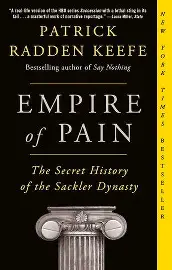
In Patrick Radden Keefe’s 2021 book, “Empire of Pain”, Keefe tells the story of the rise of the Sackler family fortune beginning with the purchase of Purdue Frederick, a pharmaceutical company, by three original Sackler brothers in 1952. The privately held business initially sold laxatives, morphine, and elixirs until it entered the pain management sector in 1991, when it formed a new entity, Purdue Pharmaceuticals.
The Sackler family’s first significant product would be a slow-release morphine pill called MS Contin, released in 1984. By revolutionizing morphine through a time-release coating that gradually released morphine into the bloodstream, patients were finally able to manage their pain outside of medical institutions.
With the success of two pharmaceutical opioid products, Percodan and Percocet, oxycodone was their next attempt to apply controlled-release opioid products in a pill. Marketed as a 12-hour pain cure, despite studies that proved otherwise, OxyContin became a breakout product.
Alongside aggressive advertising strategies, promotion, and branding, doctors, too, were assertively courted with speakers’ bureaus, free samples, and coupon cards, increasing the likelihood that their product would be chosen. Drug patenting drove up prices (and profits) while the product sold without competition for up to 20 years. Marketing was further tailored to certain demographics and geographical locations for optimal sales, particularly to high-prescribing physicians and economically distressed locations.
Believing that addiction was the result of peaks and troughs, the Sacklers' products were time-released, seemingly avoiding the addiction trap. With the assistance of an FDA employee, Curtis Wright, OxyContin packaging incorrectly claimed that addiction was reduced by the delayed absorption. After the drug was approved, Wright would exit the FDA and, within a short time, accept a lucrative job at Purdue, in what would become a revolving door between Big Pharma and Government agencies.
The Sacklers maintained that addicts with their addictive personalities were to blame for their misuse of the product and refused to accept any wrongdoing on their part. They also believed that the undertreatment of pain management was the primary cause of patients exhibiting behavior similar to that of addicts.
Within a few years, however, their own sales force would first alert the company of problems with the drug. A series of state and federal prosecutions, along with thousands of individual lawsuits, would begin to pile up against Purdue Pharma and its executives. Rather than accept any liability, Purdue executives and lawyers kept details out of the public airwaves by settling cases and having discovery files sealed. By 2008, there was an all-out epidemic of opioid deaths and overdoses.
In 2010, a new crush-resistant coating helped reduce the misuse of OxyContin, but also forced addicts to another replacement, heroin and fentanyl, with continuing dire results, creating a new epidemic of heroin use.
While the charitable Sackler family worked to get their names on museum and university buildings, they were equally good at keeping their names off any opioid story, in a cunning case of reputational laundering. By concealing their unethical business with philanthropy and good works, the Sacklers' standing in society continued unscathed for decades following OxyContin’s release.
Like Big Tobacco, the Sacklers were aware of the risks but downplayed the dangers, choosing profits over the health and well-being of their customers and the community at large. But like Big Tobacco, the Sacklers would eventually meet their end. By 2021, state and federal prosecutions would force the Sacklers to abandon their pharmaceutical business and pay a steep fine.
In the end, not even their reputations would survive.


Comments